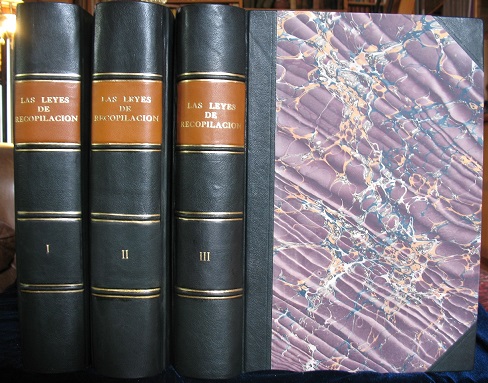
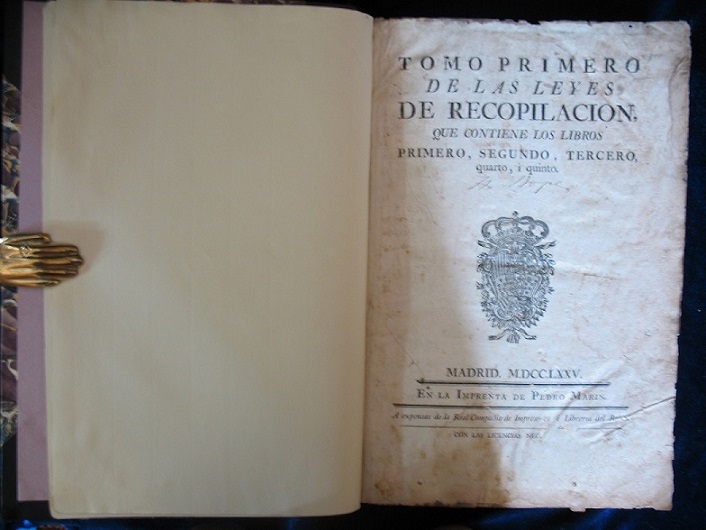
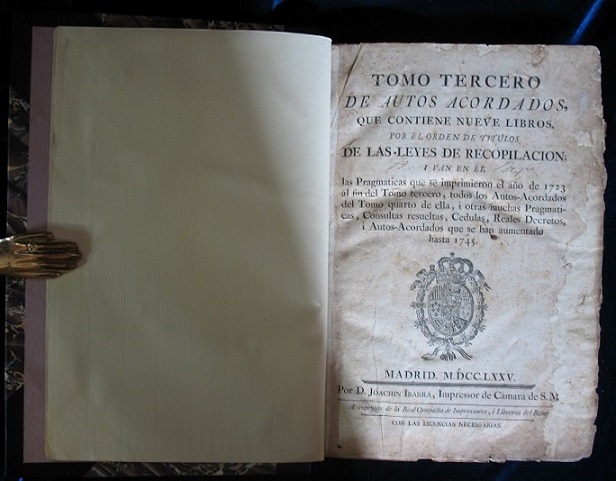
3 volumes.[12]-901 pages; [4]-794 with index pages; [12]-430, [1]-514+lxiii pages. Folio (13 3/4" x 9 3/4") bound in period half leather with red label and gilt lettering to spine with marbled boards. Volumes I and III published in 1775, volume II 1772. Volume III titled Tomo Tercero de Autos Acordados, que ontiniene nueve libros .
The Laws of the Indies (Spanish: Leyes de Indias) are the entire body of laws issued by the Spanish Crown for the American and Philippine possessions of its empire. They regulated social, political and economic life in these areas. The laws are composed of myriad decrees issued over the centuries and the important laws of the 16th century, which attempted to regulate the interactions between the settlers and natives, such as the Laws of Burgos (1512) and the New Laws (1542). Throughout the 400 years of Spanish presence in these parts of the world, the laws were compiled several times, most notably in 1680 under Charles II in the Recopilación de las Leyes de los Reynos de Indias (Compilation of the Laws of the Kingdoms of the Indies). This became considered the classic collection of the laws, although later laws superseded parts of it, and other compilations were issued. The 1680 compilation set the template by which the laws were organized. The Spanish colonies in the Americas sometimes generated conflicts between indigenous peoples ('Natives' or 'Indians') and the Spanish colonists. The Spanish attempted to control the Natives to force their labor. At the same time, conflicts on policy and implementation occurred between the colonists and the Crown. Two of the main sets of laws issued in the 16th century regulated Spanish interaction with the Native peoples, an issue about which the Crown quickly became concerned soon after the voyages of Christopher Columbus and his governorship. The Laws of Burgos (1512), signed by King Ferdinand II of Aragon, focused upon the welfare of the conquered native peoples. The issue was revisited after Bartolomé de las Casas brought attention to abuses being carried out by encomenderos. The Laws of Burgos were revised by the New Laws of 1542 issued by Charles I and quickly revised again in 1552, after the laws met resistance from colonists. These were followed by the Ordinances Concerning Discoveries in 1573, which forbade any unauthorized operations against independent native Americans. To guide and regularize the establishment of presidios (military towns), missions, and pueblos (civilian towns), King Phillip II developed the first version of the Laws of the Indies. This comprehensive guide was composed of 148 ordinances to aid colonists in locating, building, and populating settlements. They codified the city planning process and represented some of the first attempts at a general plan. Signed in 1573, the Laws of the Indies are considered the first wide-ranging guidelines towards design and development of communities. These laws were heavily influenced by Vitruvius' Ten Books of Architecture and Leon Battista Alberti's treatises on the subject.
Condition:
Attractively rebound. All titles laid down, some marginal paper repairs and staining else a very nice set.